

Miravet Castle
HOW TO GET THERE
CASTLE TIMETABLES
From 1st October to April 30th:
Tuesday to Saturday
10.00 am to 5.30 pm
Sunday and holidays
10.00 am to 3.00 pm
HOLY WEEK SCHEDULE
Friday, Saturday and Sunday
10.00 am to 7.00 pm
Monday from 10.00 am to 5.30 pm
From 1st May to September 30th:
Tuesday to Saturday
10.00 am to 7.00 pm
Sundays and holidays
10.00 am to 3.00 pm
Closed on non-holidays Mondays,
on 25th and 26th Decembre and 1st and 6th January.
The ticket office and entrance close 30 minutes before the stated closing time.
Visits to Miravet Castle by IBER, a concessionary company of the Catalan Cultural Heritage Agency.

GUIDED TOUR OF THE CASTLE OF MIRAVET
HISTORY AND HERITAGE OF THE CASTLE OF MIRAVET
- Max. 30 pax./group
- Duration
- 60 min aprox.
- Languages
- Catalan · Spanish · Other languages
- Max. 30 pax./group
- Duration
- 60 min aprox.
- Languages
- Catalan · Spanish · Other languages
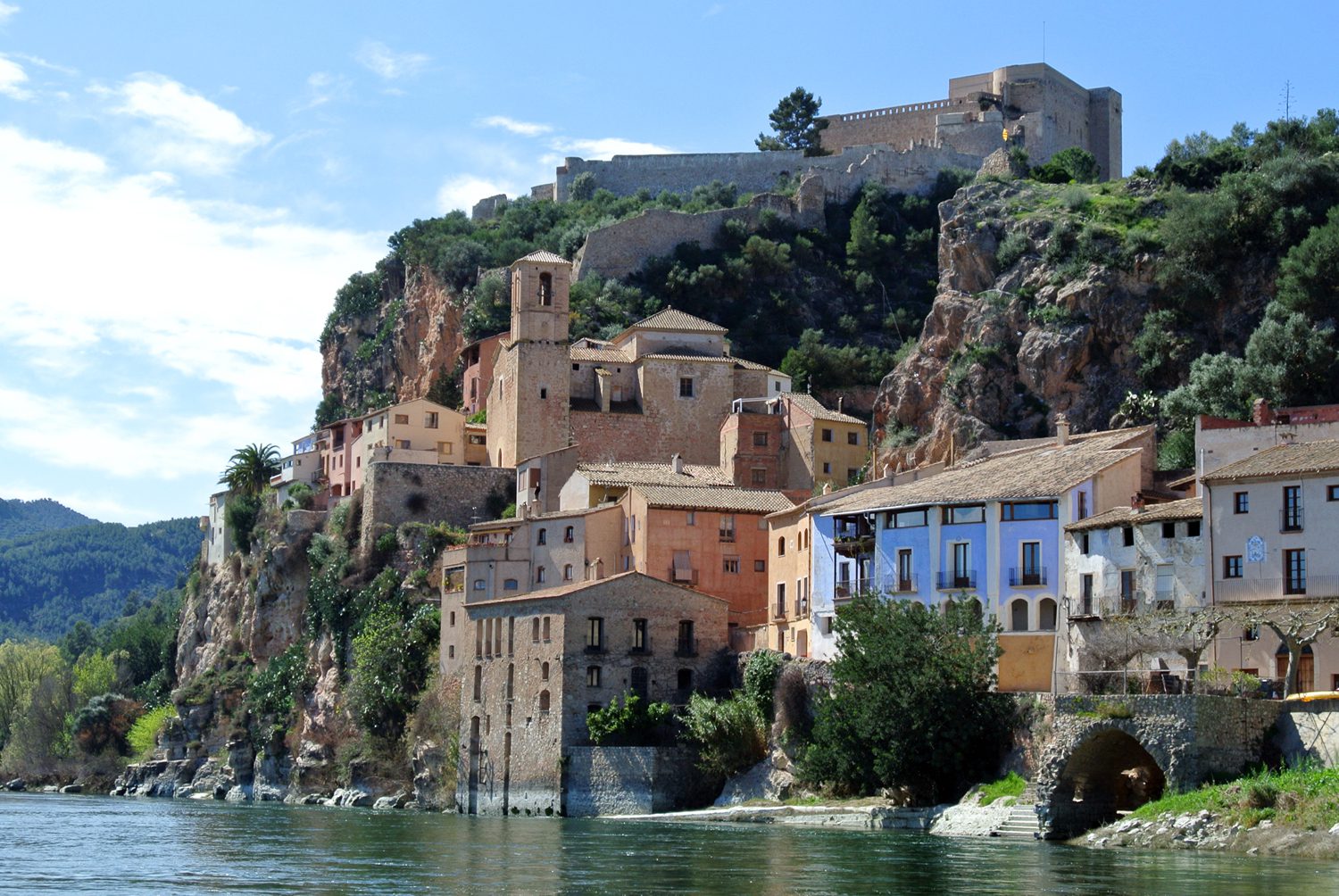
Guided tour of Miravet Castle to discover the most emblematic areas of the castle, as well as the history of the Templars and its defensive architecture. Situated on an imposing hill and surrounded by a 25-metre-high wall that seems to rise from the rock, the castle dominates the course of the Ebro River and the surrounding countryside. Its strategic location has led to a succession of settlements since Iberian times, and it has also played an important role in various conflicts. You can still see some of the structures of an Andalusian fortress on which the Templar castle was built immediately after the conquest of these lands by Count Ramon Berenguer IV. The castle was given to the Order of the Temple, which made it the headquarters of the Templar province of Catalonia and Aragon, a period of maximum power and splendour in the history of Miravet. The end of this period also marked the most dramatic episode in its history, with a siege lasting more than a year, which preceded the disappearance of the Order of the Temple.
- Visit and learn about the history of Miravet Castle.
- To learn the basics of medieval history and the Knights Templar of Miravet.
- To be aware of the evolution of societies and cultures and to promote respect for diversity and different ways of life.
- To recognise the surroundings of Miravet Castle, identify its main elements and understand the importance of its location.
- To encourage respect for and the enhancement of cultural heritage.
ARE YOU A SCHOOL?
- Max. 30 pax and 3 simultaneous groups
- Duration
- 60'
- Languages
- Catalan · Spanish · Other languages
- Price
- 79 € · 97 €


FAMILY ACTIVITIES
One treasure, three cultures at Miravet Castle
- Max. 30 pax./group
- Duration
- 90 min aprox.
- Languages
- Catalan
- Max. 30 pax./group
- Duration
- 90 min aprox.
- Languages
- Catalan
Through a game of clues based on ingenuity and search, we will find a series of objects that will allow us to access a well-guarded treasure. A different way to visit the monument. The Templar castle of Miravet, due to its strategic location and the fact that it is considered one of the best examples of Templar military architecture in Catalonia. From a more constructive and positive point of view, we will get to know the castle, but above all the numerous contributions that we have inherited through the different contacts and cultural cross-fertilisations that this area has received throughout history. Through the knowledge of the three great cultures: Muslim, Jewish and Christian, which coexisted and interacted between the 11th and 15th centuries. We will learn about the customs, traditions, great advances and discoveries that are part of our roots and our identity. A heritage that will be our great and true treasure. The activity is aimed at families/intergenerational groups, from 6 years upwards.

What are we going to do?
- Learn about the history of Miravet Castle and the Order of the Temple.
- Learn basic concepts of the Middle Ages.
- To learn about the three cultures and their relationships.
- To stimulate an interest in the past, history and our roots.
- To stimulate imagination and creativity.
- To understand the importance and artistic value of the Templar Castle of Miravet.
- Learning through play.
Miss. Stone and the mystery of the Templars of Miravet
- Max. 30 pax./group
- Duration
- 90 min aprox.
- Languages
- Catalan
- Max. 30 pax./group
- Duration
- 90 min aprox.
- Languages
- Catalan
Miss Stone travels the world in search of unique places. Curious, she travelled to Miravet Castle to study its history, meet the people who lived there and uncover some of its best-kept secrets. We will follow in the footsteps of this intrepid scholar during his visit to Miravet Castle, through his notebook and his travelling bag, which will allow us to find out everything he discovered: who were the Templars and what did they do? The activity is aimed at families/intergenerational groups from the age of six.


What are we going to do?
- Present heritage in a comprehensive and attractive way.
- Promote the stories of each monument, which help us to understand the past and bring it closer to us.
- Provide basic information about the history of the Middle Ages and the Knights Templar.
- Create a motivating and meaningful dynamic that generates experiences.
- To be aware of the evolution of societies and cultures and to promote respect for diversity and different ways of life.
- Promote respect and appreciation of cultural heritage.
ACTIVITIES EDUCATIONAL CENTRES, SCHOOLS AND INSTITUTES
Discover Miravet Castle with your senses
- Infant and primary
- Max. 30 pax./group and two groups max.
- Duration
- 90 min aprox.
- Languages
- Catalan
- Price
- 81 €
- Infant and primary
- Max. 30 pax./group and two groups max.
- Duration
- 90 min aprox.
- Languages
- Catalan
- Price
- 81 €
Children will visit the castle of Miravet through the senses of sight, smell, hearing and touch. The educator will guide the children in discovering this medieval fortress and its history, highlighting its Templar architecture and the daily life of its protagonists.


Curricular objectives
- Discover who the Knights Templar were and how they lived.
- Take an active part in the development of a story.
- Experiment with the senses (touch, smell, hearing, sight).
- Take part in a group activity, expressing your own ideas and respecting those of others.
- To arouse the children’s interest in our past.
Basic skills
- Self-awareness and personal autonomy.
- Self-awareness and emotional management.
- Play and movement.
- Progressive organisation of laterality.
- Personal and relational autonomy.
- Knowledge of the environment.
- Exploration of the environment.
- Experimentation and interpretation.
- Reasoning and representation.
- Communication and languages.
- Observing, listening and experimenting.
- Speaking, expressing and communicating.
Explore Miravet Castle
- Primary
- Max. 30 pax./group and two groups max.
- Duration
- 120 min aprox.
- Languages
- Catalan
- Price
- 97 €
- Primary
- Max. 30 pax./group and two groups max.
- Duration
- 120 min aprox.
- Languages
- Catalan
- Price
- 97 €
Pupils become explorers for a day. Equipped with a backpack full of objects: measuring tapes, binoculars, magnifying glasses, compasses and much more, they will explore Miravet Castle using mathematics, observation and ingenuity to discover how it was built.


Basic skills
- Knowledge of the natural, social and cultural environment.
- Dimension of the contemporary world.
- The knowledge dimension and interaction with the physical world.
- The technological dimension and everyday life.
- The linguistic dimension.
- Communicative, linguistic and audiovisual dimensions.
- Mathematical dimension.
- Reasoning and evidence dimension.
- Connections dimension.
- From learning to learning.
- Self-awareness dimension, individual and group learning.
- Positive attitude to learning dimension.
- Autonomy and initiative.
- Education in social and civic values.
- The personal, interpersonal and social dimension.
Curricular objectives
- Discover Miravet Castle through mathematics, observation and reasoning.
- Link the data obtained during the activity to the construction and occupation of Miravet Castle and its characteristics.
- Recognise the surroundings of Miravet Castle, identify its main elements and understand the importance of the Miravet site.
- To use different measuring and observation tools.
- To promote respect and appreciation of the cultural heritage.
M&M views on Miravet
- Secondary and high school
- Max. 30 pax./group and two groups max.
- Duration
- 120 min aprox.
- Languages
- Catalan
- Price
- 97 €
- Secondary and high school
- Max. 30 pax./group and two groups max.
- Duration
- 120 min aprox.
- Languages
- Catalan
- Price
- 97 €
Miravet was a place that attracted many artists throughout the 20th century for its colours, light and contrasts. Between 1929 and 1930, the artist Joaquim Mir spent an intense period in Miravet, during which he recorded the daily life of the village through film and painting, as well as a general overview of the period. These works have shaped a very particular vision of Miravet. A vision that is very different from the one we have today and from the one the students will see, who will experience and seek their own view of the town by confronting these two worlds.

Basic skills
- Visual and plastic education.
- Artistic and cultural competence.
- Dimension of interpretation and production.
- Perception, understanding and evaluation.
- Imagination and creativity.
- Knowledge of the natural, social and cultural environment.
- Contemporary world dimension.
- The knowledge dimension and interaction with the physical world.
- Dimension of technology and everyday life.
- Linguistic dimension.
- Communicative, linguistic and audiovisual dimensions.
- Technological dimension.
- Information processing and digital literacy dimension.
- The positive attitude to learning dimension.
- From learning to learning.
- Self-awareness dimension, individual and group.
- Autonomy and initiative.
- Education in social and civic values.
- The personal, interpersonal and social dimension.
Curricular objectives
- To use images and films as a source of knowledge about the past.
- To develop a critical eye and detailed observation.
- Understand the changes that have taken place in the castle and the Miravet area over time.
- To express ideas and reflections based on their own observations.
- To highlight the figure of Joaquín Mir and the importance of his work for the knowledge of Miravet.
WHAT TO SEE IN THE CASTLE?
Miravet, Testimony of Wars
- Max. 30 pax./group
- Duration
- 90 min aprox.
- Languages
- Catalan · Spanish
- Max. 30 pax./group
- Duration
- 90 min aprox.
- Languages
- Catalan · Spanish
Guided tour of the monument, focusing exclusively on a very specific aspect of the castle and the main reason for its construction. Its value as a military fortress and its importance in this sense throughout history have made it an impregnable stronghold and the best example of medieval feudal European military architecture, which, due to its deliberate characteristics, has never been taken by attack. Miravet Castle is located on a hill overlooking an important stretch of the Ebro River. The fortress was built between two ravines that make it practically inaccessible, so it had a remarkable natural protection, and the construction of the various defensive means is based on these morphological features. For this reason, the Castle of Miravet has been the protagonist of the most important episodes of warfare in our history, which have left their mark, such as the medieval feudal wars of Miravet against the Entença, which led to 10 years of feudal conflict in the 13th century, the siege of the Castle of Miravet and the end of the Templars (1308), The Catalan Civil War (15th century), the War of the Reapers (17th century), the War of Succession (18th century), the Seven Years’ War or First Carlist War (19th century) and the Third Carlist War (1872-1876), and finally the last conflict, the Spanish Civil War (20th century).